
 Opens in new window
  Opens in new window
  Opens in new window
  Opens in new window
 Warbird Roundup Warbird Information
*This page is continuously updated as plane information changes. Check back often for the latest information.
NORTH AMERICAN
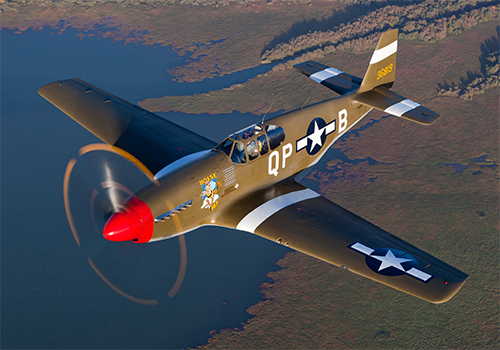
P-51C MUSTANG
BOISE BEE
The Warhawk’s P-51C is painted in the markings of Boise native and 5x fighter ace Lt. Col. Duane W. Beeson. Beeson flew in the 334th Fighter Squadron, 4th Fighter Group, Eighth Air Force in England. Among one of the most famous fights of WWII, the P-51 has roots in both Britain and the U.S. Originally overlooked by the USAAF, the P-51 did not see action with American forces until March 1943. The combination of American airframe and British Rolls-Royce Merlin engine made it unmatched by any other piston aircraft of the time. The Boise Bee was restored to flying condition and made it’s first post-restoration flight in 2010.
CURTISS
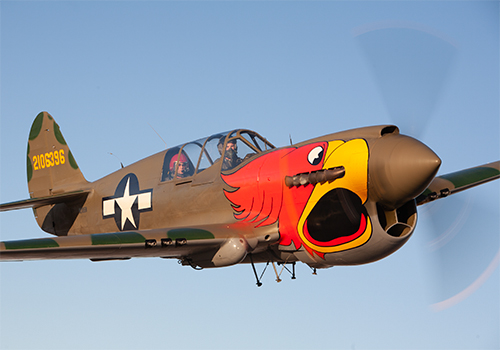
P-40N WARHAWK
PARROT HEAD
The P-40 was America’s foremost fighter in service when WWII began. Though often outclassed by its adversaries in speed, maneuverability, and rate of climb, the P-40 earned a reputation in battle for extreme ruggedness. At the end of it’s career, more than 14,000 had been produced for service in the air forces of 28 nations. The Warhawk’s P-40N was restored to flying condition in the 1980s, made its first post-restoration flight in 1986, and is painted in the markings of the “Parrot Head” squadron of the class of 43K Dothan, Alabama. It was used in the filming of the movie Pearl Harbor.
CURTISS
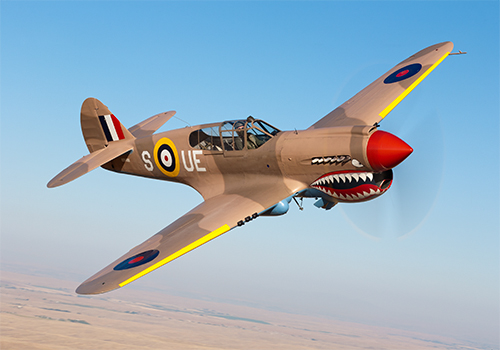
P-40E KITTYHAWK
SNEAK ATTACK
The Warhawk’s P-40E Sneak Attack was restored in the late 1960s and made its first post-restoration flight in 1971. Sneak Attack’s markings honor the Royal Air Force 112th “Shark Squadron” that operated in North Africa during WWII. The SUE on the side honors owner John Paul’s wife Sue.
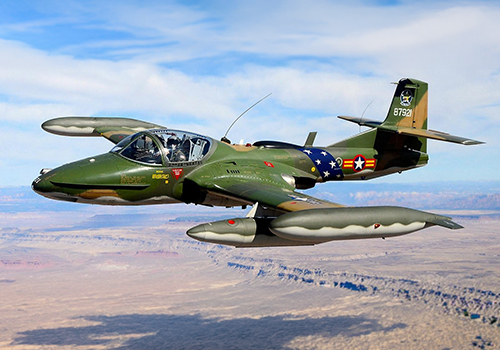
CESSNA A-37B DRAGONFLY
This Dragonfly was built in 1968 in Wichita, KS. The A-37B was to replace the A-1D Skyraider that was being lost in combat at an alarming rate. The first production aircraft were sold to Vietnam and this A-37 found its way to Da Nang and assigned to the 41 Tactical Fighter Group, the 516th squadron of the VNAF. Known as the Fighting Tigers, the “Phi Ho” squadron became one of the best known and accurate attack squadrons in Vietnam. It eventually found its way to Australia. When President Clinton, by Presidential Order, released all claim and ownership rights to all equipment left behind in Vietnam it allowed this aircraft to be sold to a US buyer for restoration to flight status once again.
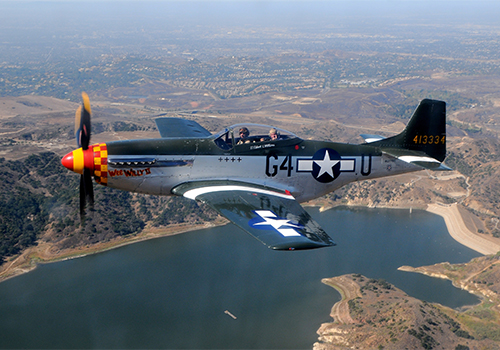
North American P-51D Mustang
Wee Willy II
Wee Willy II comes to us from the Planes of Fame Air Museum in Chino, CA. It was manufactured in Dallas, Texas and delivered into service in late 1944. Wee Willy II has the soul of a racer. After serving with several Air National Guard units, it went into private ownership in 1958 and converted into an air racer in 1964. This P-51D set the world speed record for piston engines in 1979 when it was known as Red Baron. A devastating crash in 1979 destroyed the aircraft, but portions were salvaged and combined with parts from other Mustang variants to build Wee Willy II.
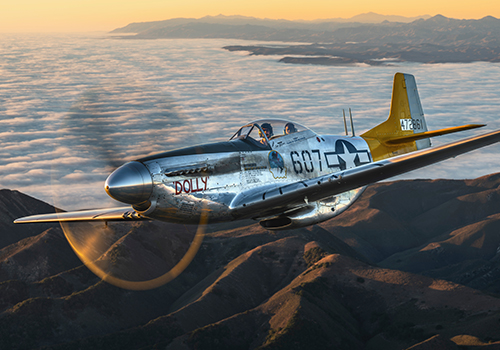
North American P-51D Mustang
DOLLY
Dolly was the 40th (of 200) P-51D-30 variant built in Dallas, Texas and delivered into service on July 26, 1945, but went immediately into storage at Kelly Field, San Antonio, Texas. In late 1947, it was assigned to the 31st Fighter Group (Turner Air Force Base, Albany, GA), serving with the Strategic Air Command until that unit transitioned to jet aircraft. From March 1949 until December 1956, the aircraft served with Air National Guard units in Tennessee, Vermont, and West Virginia. Planes of Fame acquired the aircraft in November 1957, making it the longest privately held P-51D under the same owner.
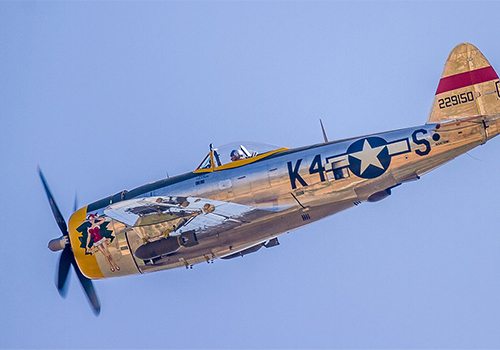
Republic P-47D Thunderbolt
Dottie Mae
By 1944, pilot Lt. Lawrence “Larry” Kuhl had 17 missions under his belt when he was given this Thunderbolt, which he named Dottie Mae after his wife. On December 16, 1944, Dottie Mae flew the first of 90 combat missions over the next five months. Kuhl flew 39 of those missions. On May 8, 1945, twenty P-47s were sent on an “aerial demonstration” flight to boost morale at a newly liberated POW/concentration camp in Austria. Dottie Mae’s pilot, Lt. Henry Mohr, flew too low over Traunsee Lake and struck the water. Mohr escaped, but Dottie Mae spent the next 60 years at the bottom of the lake before being discovered in 2005. WWII veteran Jack Croul purchased Dottie Mae and had her fully restored using much of her original parts. Dottie Mae was revealed to the pubic for the first time at the 2017 Warbird Roundup.
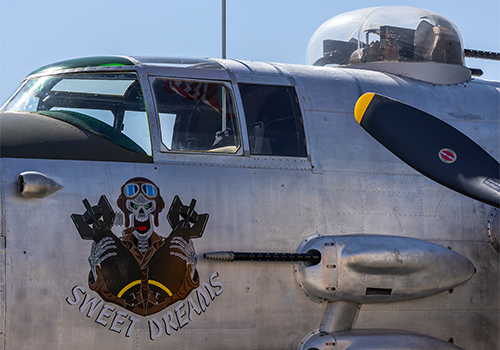
North American B-25J Mitchell
Sweet Dreams
On July 6, 1945, this B-25J joined the U.S. Army Air Force at Yuma Air Field in Arizona. In 1959, she was sold, but by the 1980s was in disrepair and no longer flying. She changed hands several times and rechristened Old Gray Mare and Samantha.
She is now fully restored in the markings of the 345th Bombardment Group known as the Air Apaches and flies under the name Sweet Dreams. The 345th was sent to the Pacific during World War II. Once in theater the B-25s were converted into “strafers” making them a low level ground and shipping attack plane. After Japan’s surrender, the 345th was tapped to escort the Japanese delegation to Manila for a conference with General MacArthur to discuss their formal surrender. The unit was one of the most decorated of WWII.
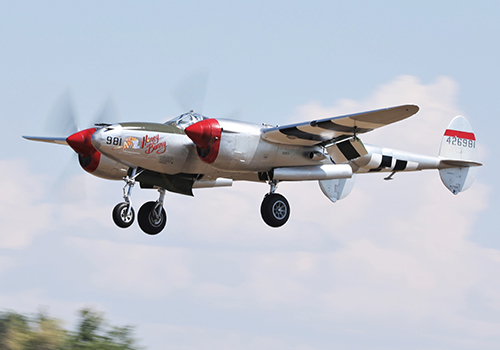
Lockheed P-38L Lightning
Honey Bunny
Honey Bunny was delivered to the Army Air Force in 1944 and converted into an F-5G for photo reconnaissance work. Aero Exploration Company Incorporated of Tulsa, Oklahoma acquired it from the War Assets Administration in 1946 for $1,250.
Despite changing hands many times over the years, she remained relatively active and flew under several names. In 2010, she was christened Honey Bunny and her iconic nose art was added.
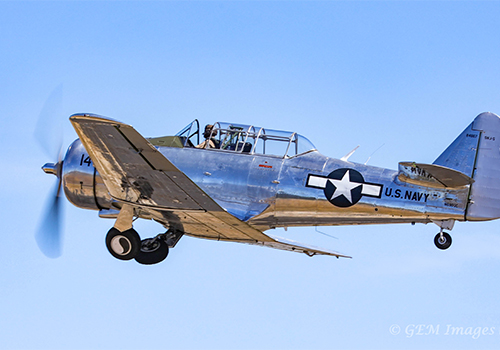
North American SNJ-5 Texan
Lil’ Ashlee
Designed by North American Aviation, the T-6 is a single-engine advanced trainer used by the U.S. Armed Forces to train pilots during WWII and on through the 1970s.
The T-6 is known by a variety of designations depending on the model and operating air force. The U.S. Army Air Corps and the Army Air Force called it an AT-6 while the Navy called it an SNJ and the British a Harvard. In 1948, the new U.S. Air Force designated it the T-6 and the Navy followed in 1962.
T-6s have also been used to simulate various historical aircraft including the Japanese Mitsubishi A6M Zero.
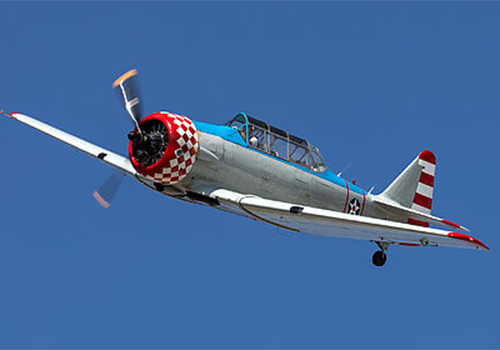
North American Harvad Mk. IV
Originally a Harvard Mk. IV built in 1952 by Canadian Car and Foundry, this warbird spent 12 years serving in the RCAF before being retired to the bone yard at Davis Monthan. In the late 1980s a group purchased a block of T-6s from Davis Monthan, and this one was restored. In 2021 it was purchased by the current owner and the exhaust, canopy, and gear doors were updated to make it look like a T-6.
This aircraft is equipped with a Pratt and Whitney R-1340–AN2 engine with a gearbox on the front making it extremely quiet compared to a traditional T-6.
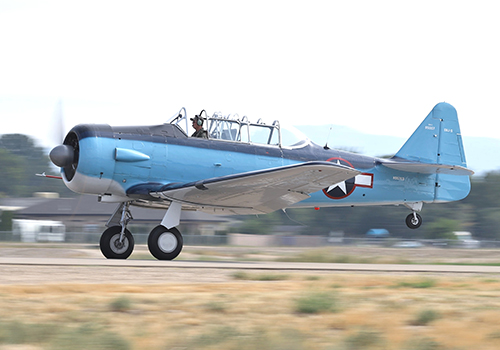
North American SNJ-5B Texan
North American built 15,495 Texans between 1938 and 1955. They were designed to give the best possible training in all types of tactics, from ground strafing to bombardment and aerial dog fighting. The AT-6G/SNJ-5 included major advancements such as a full-time hydraulic system and a steerable tail wheel. During the Korean War, they were used as forward air controllers designating targets for and coordinating UN air strikes.
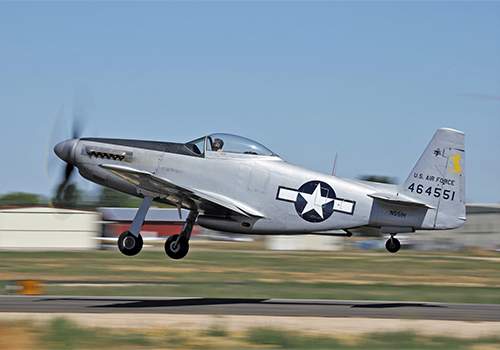
North American P-51H Mustang
North American developed several P-51 variants – the H being a total new design and overhaul. Some of the updates included a different wing shape, taller tail, and smaller landing gear. The fuselage was more slender and the length increased to 33.33 feet while the belly scoop inlet profile was square again like the first P-51s.
The Rolls Royce Merlin V-1650-9 engine made it the fastest production P-51, but it did not reach front-line units in time to see combat. Only a handful of H models survive and only two are airworthy.
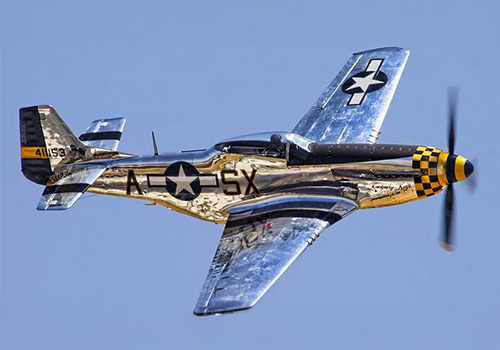
North American P-51D Mustang
Kimberly Kaye
This P-51 started life as a P-51K with the US Air Force before being sent to the Indonesian Air Force. From 1980-1985 she was on display at an Indonesian military cemetery. When she returned to the US in 1985, she spent several years in restoration going from a B to D model. She took her first post restoration flight in 2002 and was christened Kimberly Kaye.
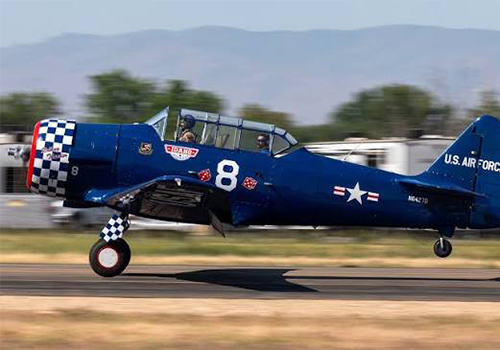
North American SNJ-4 Texan
Rolling Thunder
The SNJ is better known as the Army AT-6 or the British Harvard. Most SNJs and AT-6s were manufactured in the Dallas, Texas North American factory – hence the name Texan.
The Navy added tail hooks to some of their SNJs for carrier training. It was also used for gunnery training. The US did not use this plane for actual combat until the Korean War, where it proved itself very well. Two fixed Browning ANM2 30 cal. machine guns in the wing and right front cowling, plus another rear gunner “flexible” gun gave the SNJ plenty of firepower. It was also designed to handle bombs and rockets.
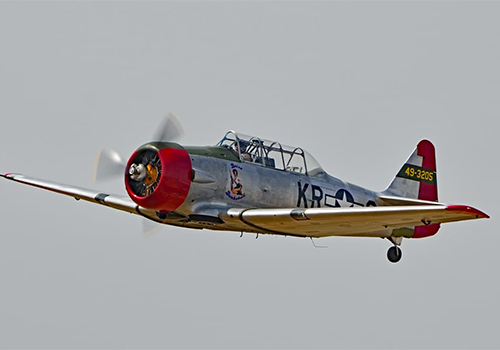
North American T-6G Texan
Boise Bombshell
The Texan was the classroom for most of the Allied pilots who flew in World War II. Called the SNJ by the Navy and the Harvard by the British Royal Air Force, it was designed as a transition trainer between basic trainers and first-line tactical aircraft. In all, 34 different countries over a period of 25 years used the Texan to train pilots. Although not as fast as a fighter, it was easy to maintain and repair, had more maneuverability and was easy to handle. It could roll, loop, spin, and vertical roll. It was designed to give the best possible training in all types of tactics from ground strafing to bombardment and aerial dog fighting.
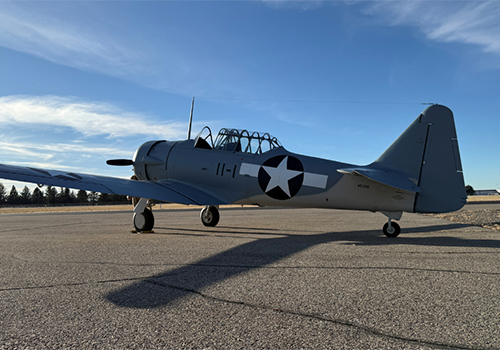
North American SNJ-4 Texan
During World War II tens of thousands of young men trained to be U. S. Army pilots and Naval aviators in the Texan. After advanced training they went on to operational units where they refined their skills before flying in combat in Europe, Asia, and the Pacific. Without the Texan it would have been difficult to train the enormous number of pilots required. The SNJs in the U. S. Navy not only trained student Naval aviators to fly from training airfields but also trained them in the demanding techniques of carrier landing and take offs. The SNJ-4C (C for carrier modification) included an arresting hook that enabled student aviators to become carrier qualified.
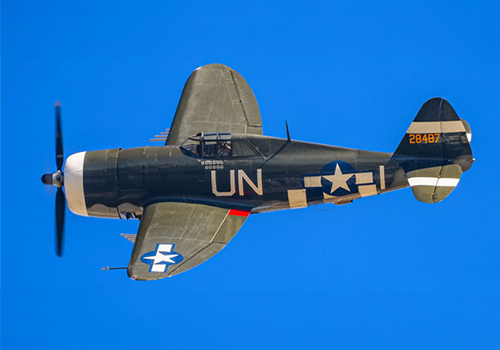
Republic P-47G Thunderbolt
Planes of Fame Air Museum’s P-47G spent most of its military career as a fighter trainer in the western part of the USA. After World War II, the Thunderbolt was used as an instructional airframe at Grand Central Airport in Glendale, California. In 1952, Ed Maloney obtained the aircraft and stored it at his home with the intention of eventually displaying it in his projected air museum. The Thunderbolt was finally reassembled in 1963 and took part in a number of west coast airshows until it was damaged in a forced landing in 1971 and put into storage. Although the primary goal was to get the Thunderbolt back into flying condition, lack of a suitable replacement engine delayed that event until 1985. Over the years, it has appeared in a number of different color schemes before it reappeared in a very accurate paint scheme as 42-8487 Spirit of Atlantic City, N.J.
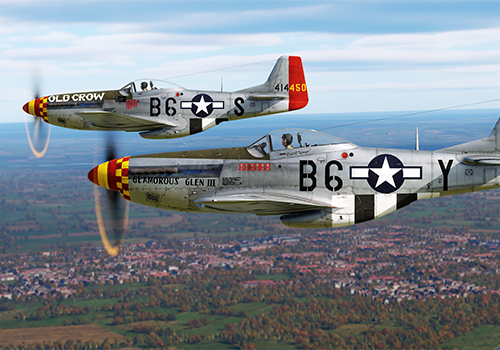
P-51D Mustang
Glamorous Glen III
This P-51D Mustang from WWP Legacy Warbirds began its service in 1944 with the United States Army Air Force before being transferred to the Royal Canadian Air Force in 1947. It was sold into private hands in 1963 for $500 and restored in 1964 with a purple paint scheme. Through the years she has changed hands many times and flown under several paint schemes. In 2006, she was given her current paint job in honor of General Chuck Yeager and named Glamorous Glen III. During WWII, Chuck Yeager named his planes after his then fiancé Glennis Faye Dickhouse – the first P-51B named Glamorous Glen, the second P-51C Glamorous Glen II, and lastly his P-51D Glamorous Glen III. This final P-51 is the one in which he achieved most of his aerial victories.
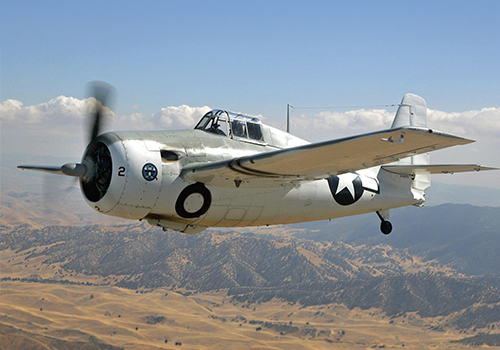
General Motors FM-2 Wildcat
Grumman’s Wildcat production ceased in early 1943 to make way for the newer F6F Hellcat, but General Motors continued producing Wildcats for the U.S. Navy. At first, GM produced the FM-1 (identical to the F4F-4 but with four guns) before production switched to the improved FM-2 (informally known as the Wilder Wildcat) optimized for small-carrier operations with a more powerful engine and a taller tail. Built by the Eastern Aircraft Division of General Motors, this FM-2 Wildcat was taken on strength by the US Navy. Originally slated to be converted into an agricultural sprayer, the aircraft remained stock until a landing accident in 1972, when it was stored, later sold to a new owner, and didn’t fly again until 2003. It is now owned by WWP Legacy Warbirds.
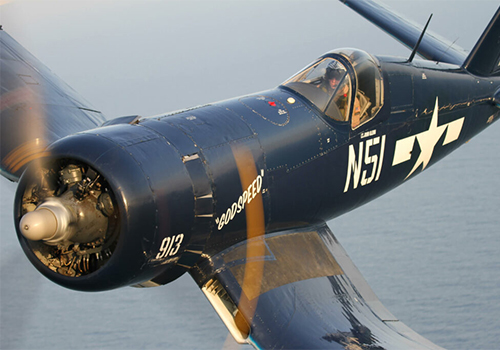
Goodyear FG-1D Corsair
Godspeed
This Goodyear-built FG-1D Corsair is one of the few remaining aircraft of its kind. It has been re-painted in fictitious markings to honor Senator John Glenn, Mercury astronaut and former US Marine Corps pilot. This aircraft was formerly known as ‘Sky Boss’, but its new moniker ‘Godspeed’ refers to the comment made by fellow astronaut Scott Carpenter to Glenn as he blasted off to become the first US astronaut to orbit the Earth. It is now owned by WWP Legacy Warbirds.
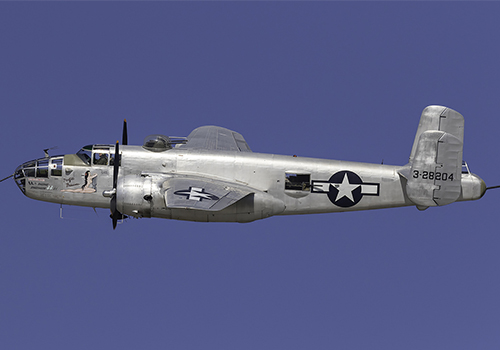
North American B-25J Mitchell
Pacific Princess
Pacific Princess was completed on June 12, 1944, by North American Aviation. Her service began in Florida, where she was used for aerial gunnery training at Kissimmee and Orlando Field before serving as a staff proficiency aircraft at Brooks Field, Texas. She was sent into storage at Davis-Monthan Air Force Base in Arizona before being sold into civilian hands. As a civilian, Pacific Princess began her firefighting career when she was converted into a 1,000-gallon fire tanker in May 1959. She has also been used in Hollywood productions such as the 1970 film Catch-22, Steven Spielberg’s 1941, and painted as “Whirling Dervish” in the 2001 feature film Pearl Harbor. Perhaps the most meaningful endeavor was her involvement in the US Navy aircraft carrier launches commemorating the historic Doolittle Tokyo Raid. Pacific Princess led the overhead formation for the USS Ranger (CV-61) launch in 1992.
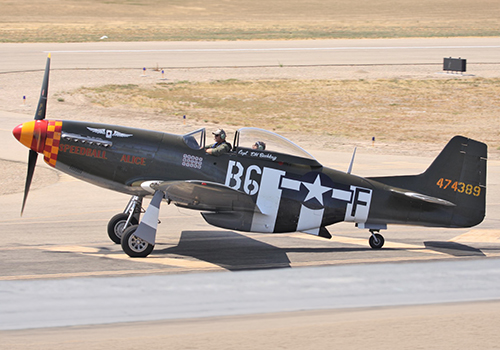
North American P-51D Mustang
Speedball Alice
Speedball Alice is a post-war warbird originally delivered to the Royal Canadian Air Force on June 7, 1950, where she served until September 20, 1960. As a civilian, she became a staple of West Coast air shows and the Reno Air Races. Rebuilt in Shafter, California, in 1982, she initially flew under the name Million Dollar Baby before being officially renamed Speedball Alice in 2000 to honor World War II ace Major Donald H. Bochkay of the 357th Fighter Group.
North American P-51D Mustang
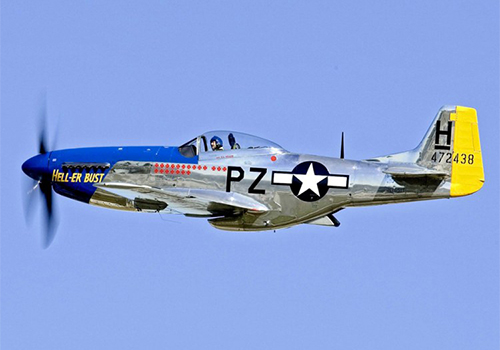
Hell-er Bust
The P-51D Mustang incorporated several improvements over earlier designs and became the most numerous variant with nearly 8,000 being built. The most obvious change was a new “bubble-top” canopy that greatly improved the pilot’s vision.
The P-51D also received the new K-14 gunsight, an increase from four to six .50-cal machine guns, and a simplified ammunition feed system that considerably reduced gun jams. The P-51D arrived in quantity in Europe in the spring of 1944, becoming the USAAF’s primary long range escort fighter. Few Luftwaffe aircraft could match the P-51D, and by the end of the war Mustangs had destroyed 4,950 enemy aircraft in the air, more than any other USAAF fighter in Europe. Hell-er Bust is painted in the markings of WWII Fighter Ace Capt. Edwin L. Heller who flew in the 486th Fighter Squadron of the 352nd Fighter Group.
Grumman F6F-3 Hellcat
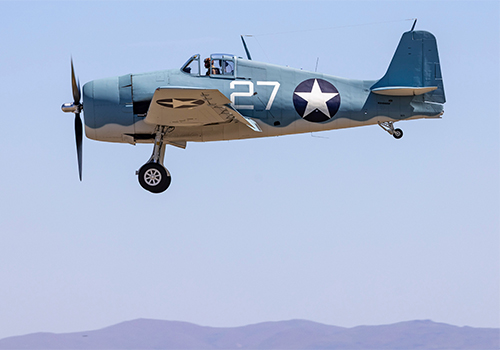
The F6F Hellcat is a carrier-based fighter aircraft of World War II designed to replace the F4F Wildcat and to counter the Japanese Mitsubishi A6M Zero. It was the United States Navy’s dominant fighter in the second half of the Pacific War, prevailing over its faster competitor, the Vought F4U Corsair, which initially suffered from several carrier-operating issues. The F6F made its combat debut on August 31, 1943, during raids on Marcus Island – establishing itself as a rugged, well-designed carrier fighter, able to outperform the A6M Zero. Hellcats were credited with destroying a total of 5,223 enemy aircraft while in service with the U.S. Navy, U.S. Marine Corps, and Royal Navy Fleet Air Arm – more than any other Allied naval aircraft. After the war, Hellcats were phased out of front-line service in the US, but radar-equipped F6F-5Ns remained in service as late as 1954 as night fighters. This specific Hellcat has recently gone through an extensive restoration at Vintage Airframes in Caldwell, Idaho, and makes its first public appearance at the Warbird Roundup.
North American T-6G Texan
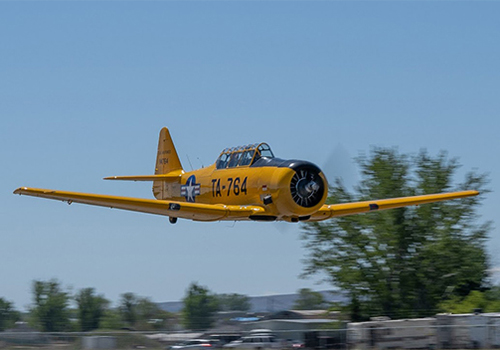
Mary Virginia
The North American Aviation T-6 Texan is a single-engine advanced trainer used to train pilots of the United States Army Air Forces and Navy, the Royal Air Force, and other air forces of the British Commonwealth during World War II and into the 1950s. It earned the nickname “pilot maker” as it was the final hurdle facing pilot candidates in preparing them for combat.
The T-6 was known by a variety of designations depending on the model and operating air force. In the US the Army Air Corps designated it an AT-6 while the Navy called it an SNJ. British Commonwealth air forces referred to it as a Harvard – the name it is best known by outside of the United States. Re-designated as T-6s in 1948, a total of 15,495 of all variants were built.
Noted for their safety record and maintenance reliability over the years, the T-6 variants trained thousands of pilots as well as being used for gunnery training and as observation aircraft. Some countries have even used them as fighters. The South Africa Air Force was the last known military to use Texans as trainers in 1995, which gives it a working history of 60 years.
The T-6 remains a popular warbird used for airshows, static displays, and simulating Japanese aircraft in movies depicting WWII in the Pacific. The Warhawk Air Museum, through donations, was able to purchase this T-6G from the estate of Anthony “Tony” Banta. Tony was an Air Force test pilot, an astronaut candidate, and a restorer of historic military aircraft.
North American T-6G Texan
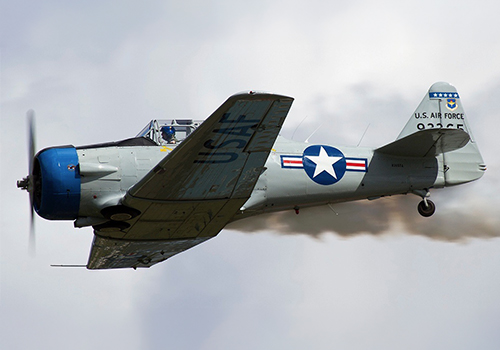
This T-6G was built by North American in 1951 and began service with the US Air Force in May of that same year. In 1953, she was damaged after a collision with another T-6 at Bainbridge Air Base (now closed) in Georgia. In 1958, she was put on a ship and delivered by the US Navy to Santander, Spain and towed to Parayas airport where she was prepared to be ferried to Matacan Air Base, Salamanca, and delivered to the Spanish Air Force. She was used as a trainer for Spanish pilots until 1983, when she was returned to the US Government, sold at auction, and once again on American soil.
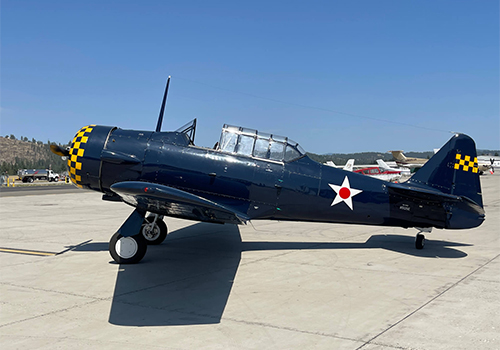
North American SNJ-5 Texan
The North American T-6 Texan was known by many official military designations and international names, including the AT-6, SNJ, and Harvard, alongside famous operational nicknames like the Pilot Maker. North American Aviation designated it the Texan because the vast majority (nearly 13,000 out of roughly 15,400 total units) were produced at its massive wartime manufacturing facility located in Grand Prairie, Texas. The US Army Air Corps and Army Air Forces called it an AT-6 for advanced trainer. The US Navy called in an SNJ – the S for Scout to indicate its reconnaissance role, N being the standard letter code assigned to training aircraft, and J the specific code assigned to the manufacturer, North American Aviation. T-6 became the unified designation adopted by the US Air Force in 1948 and the Navy in 1962. Aside from its most famous nickname Pilot Maker, modified T-6s used as forward air control and target-spotting during the Korean War were known as Mosquitos.
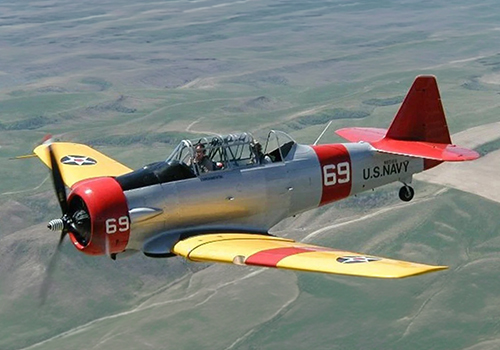
North American SNJ-5 Texan
With over 17,000 delivered to the U.S. military and numerous foreign nations, the Texan is the most widely used trainer ever. The earliest version was an open cockpit monoplane with fixed landing gear and a fabric covered fuselage, but with the 1938 introduction of the SNJ-1, it evolved into an all-metal aircraft with retractable landing gear. Two generations of Naval aviators trained in the SNJ, and a number of aviators made their first carrier landings in the aircraft. An SNJ played an important role in the development of the modern aircraft carrier when it was utilized in 1953 to test day/night touch-and-go and arrested landings and takeoffs in winds of varying force and direction on the Navy’s first angled deck aircraft carrier, Antietam (CVA-36).
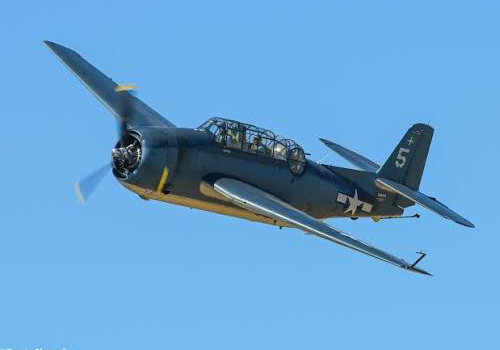
General Motors TBM-3U Avenger
Originally constructed as a TBM-3 by General Motors, she was converted to a TBM-3U in 1945 and delivered to the United States Navy. This conversion mean that all her offensive and defensive weapons were removed and a target-tow reel was installed in the rear fuselage for training exercises. In 1978, she was operating in an aerial fire suppression and support role in Arkansas. In 2015, her new owner gave her “She’s the Boss” nose art which was later removed. She has the distinction of being one of the lowest-hour, highly original flying Avengers remaining, featuring operational folding wings, bomb bay doors, and a functional rear gun turret.