Opens in new window
  Opens in new window
  Opens in new window
  Opens in new window
 Yak-18
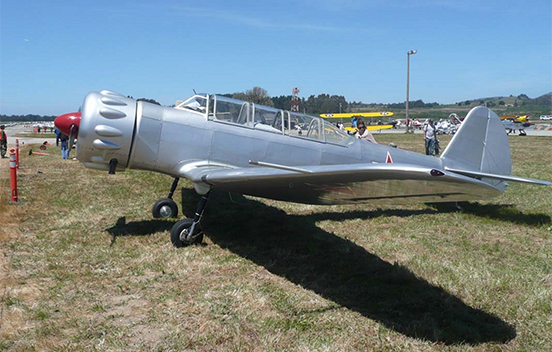
Yakovlev Yak-18
The Yakovlev Yak-18 (NATO reporting name, Max) is a tandem two-seat military primary trainer aircraft manufactured in the Soviet Union. Originally powered by one 119 kW (160 hp) Shvetsov M-11FR-1 radial piston engine, it entered service in 1946.
It was developed by the Soviet Design Bureau OKB Yakovlev (OKB-115). Early variants of the Yak-18 were equipped with a conventional (taildragger) landing gear. The Yak-18 was also license-built in the Peoples Republic of China as the Nanchang CJ-5 and the CJ-6 (Yak-18A).
This particular aircraft was built in Russia in 1954 and shipped to China, where it was used until the early 1970s. It came to the USA in 1986, and was restored by Robert Kantner of Schellville, CA in 1993 using a 240 HP Continental W670-23 engine and prop combination from a wrecked Cessna 190. Original pneumatic systems were converted to electric/hydraulic.
There are approximately 50 left worldwide of which 10 are currently capable of flight: 5 in the USA, 1 in China, 1 in Australia, 1 in Belgium, 1 in Poland, and 1 in Germany.
Yak-18s did have a brief military career during the Korean War. They flew nuisance “Bed Check Charlie” missions over Allied lines at night, dropping small bombs. These did no significant military damage but disrupted the sleep of the soldiers.
Yakovlev Yak-18 Specifications
- Built:
Entered service in 1946, Yakovlev, Soviet Union - Engine:
Ivchenko AI-14R
9-cylinder radial piston
- Length: 8.53 m
- Height: 3.35 m
- Wingspan: 10.60 m
- Empty Weight: 1,025 kg
- Max Weight: 1,316 kg
- Range: 750 km
- Service Ceiling: 5,060 m
- Max Speed: 262 km/h